F&B Chain (Malaysia) Standardising OT + Cut-Off to Stop “Last-Minute Payroll”
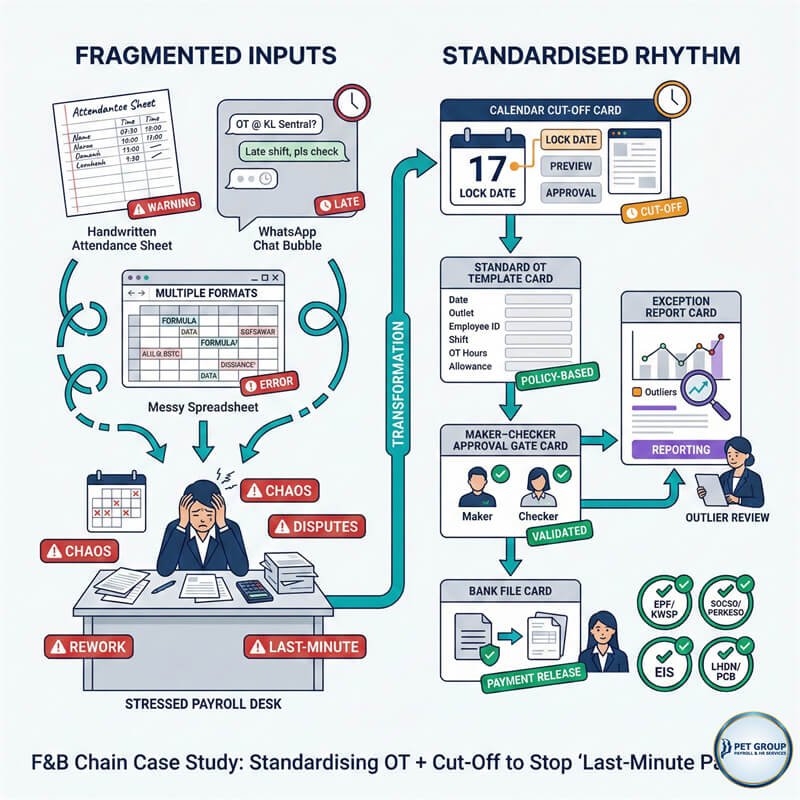
Shift work and OT became manageable once we enforced a clear cut-off, standard rules, and approval workflow. This anonymised case study explores how PET Group redesigned the monthly payroll operational rhythm for a multi-outlet F&B chain (~60–120 staff) in Malaysia, moving them from administrative chaos to a predictable, audit-ready cycle across Klang Valley and Johor.
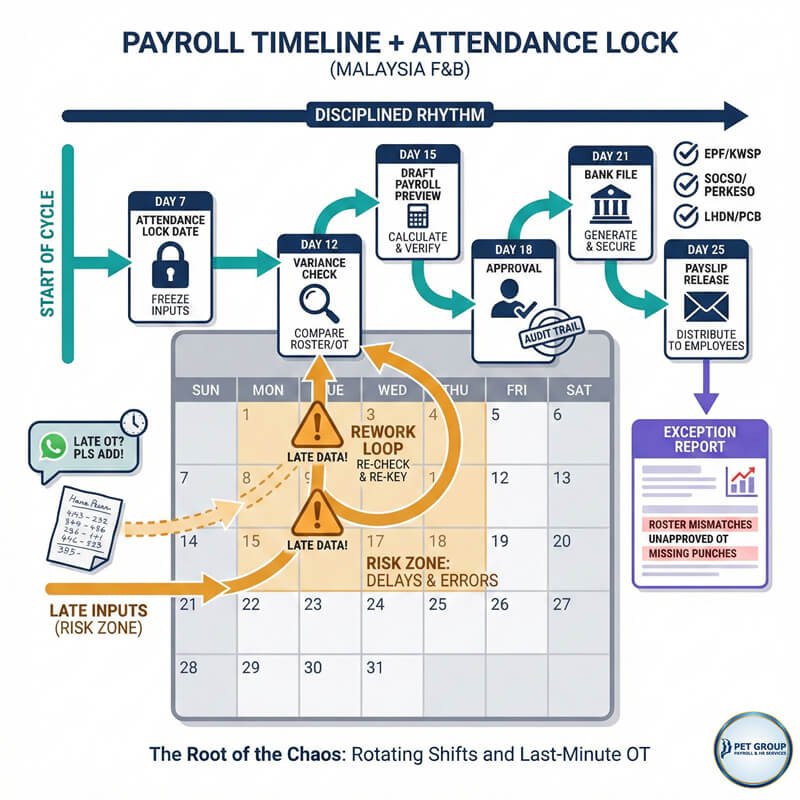
The Root of the Chaos: Rotating Shifts and Last-Minute OT
Why do F&B businesses face “last-minute payroll”? In most restaurant chains, “last-minute payroll” is caused by a lack of synchronisation between outlet-level operations and the central payroll desk. In this case study, a multi-outlet operator with staff across KL and Selangor hubs like Petaling Jaya (PJ) and Bangsar struggled with rotating shifts and high OT variability. Outlet managers often sent attendance data late or in mixed formats (handwritten, WhatsApp, or varied spreadsheets), leading to a month-end rush that increased the risk of missing statutory timelines for EPF (KWSP), SOCSO (PERKESO), and PCB (LHDN).
The absence of a formal “attendance lock date” meant that data was constantly shifting even as payroll was being processed. Manual adjustments were frequent, leading to inconsistent payslips and employee disputes over shift allowances. Whether the outlets were in Mont Kiara or Mount Austin (JB), the problem was the same: the lack of a standard cut-off calendar made payroll reactive rather than systematic. At PET Group, our objective was to standardise these inputs and establish clear maker-checker controls to move the SME from reactive crisis management to a predictable administrative rhythm.
Root cause analysis revealed that approvals were often “WhatsApp-based,” leaving no audit trail for changes. This made it difficult for finance managers to verify OT outliers or investigate spikes in labor costs. By introducing a structured payroll outsourcing case study Malaysia approach, we demonstrated that operational control is not just about software, but about process design. We focused on standardising timesheets and enforcing a strict approval window, ensuring that management in locations like Cheras, Kepong, or Skudai had full visibility into exceptions before the final bank file was generated.
PET Group acts as the senior operations lead for your F&B payroll outsourcing Malaysia needs. We help you move beyond “last-minute” salary runs by implementing disciplined schedules that align with Malaysian labor standards and regional banking realities.
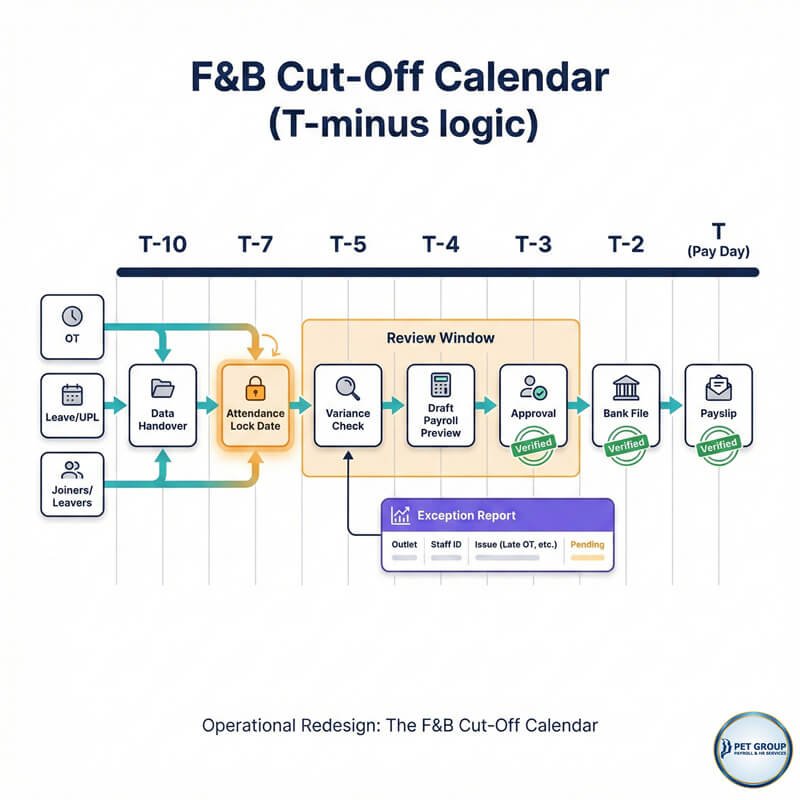
Operational Redesign: The F&B Cut-Off Calendar
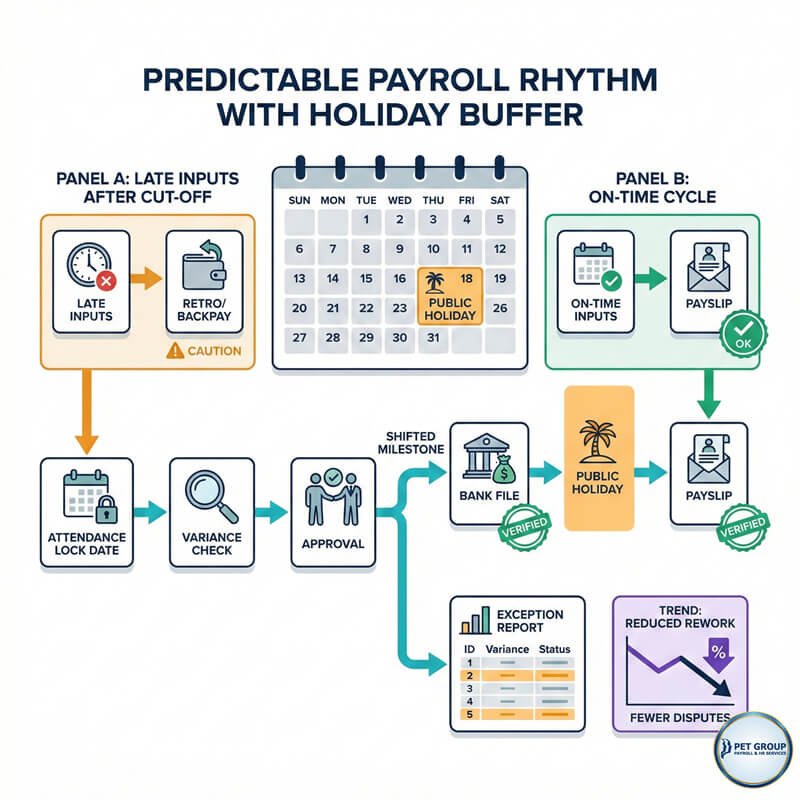
What is a payroll cut-off calendar? A payroll cut-off calendar is a documented monthly schedule that defines exactly when employee attendance data must be locked, when draft reviews must occur, and when final payments are released. For our F&B client with outlets in areas like Sri Petaling, Ampang, or Damansara, we implemented a relative “T-minus” timing logic. This ensures that even with rotating shifts, the “handover” of data happens with enough buffer time to perform necessary variance checks on OT and shift allowances before statutory deadlines.
Choosing the right payroll cut-off date Malaysia for F&B requires balancing accuracy with bank file processing times. In this case study, we established an “Attendance Lock Date” (e.g., the 20th of the month) which serves as the data freeze point. This allows management in Klang or Pasir Gudang to verify all hours worked before the data reaches PET Group. This discipline prevents retroactive adjustments from cluttering the current cycle and ensures that PCB (MTD) calculations are based on verified, final figures, significantly reducing payslip disputes across the group.
A firm cut-off date is the first step toward predictable restaurant payroll Malaysia. By standardising this deadline across all outlets in Kuala Lumpur and Johor Bahru, we ensure that every payroll run is grounded in verified data, leading to a professional and audit-ready month-end rhythm.
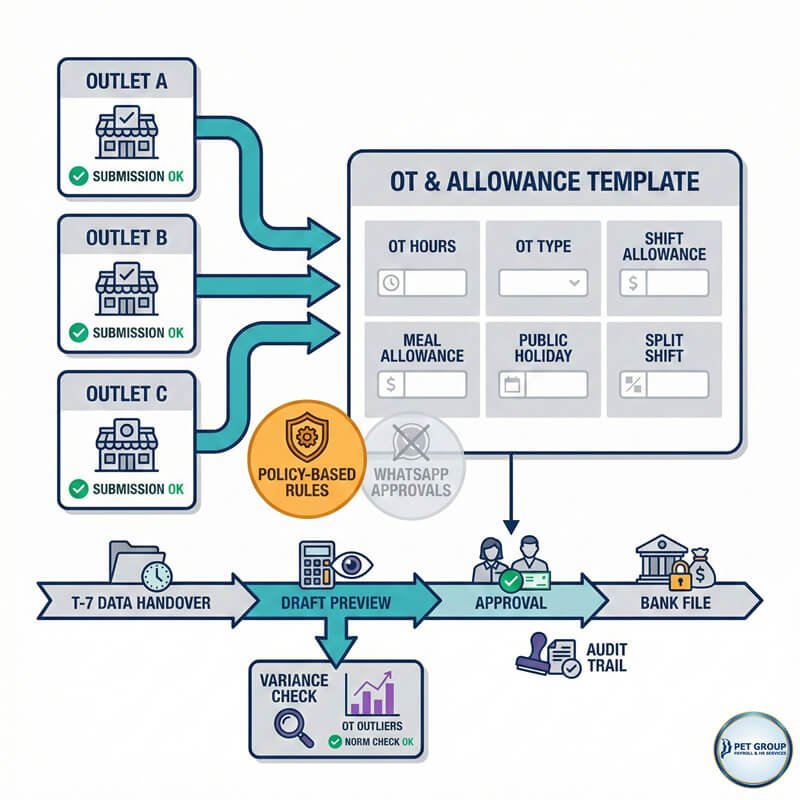
Standardising OT: From WhatsApp to Policy-Based Rules
What is the simplest way to standardise OT across multiple outlets? The most effective approach is to move from informal “WhatsApp approvals” to a policy-based system with clear definitions and consistent inputs. For our F&B client, we replaced fragmented outlet submissions with a single standardised OT/shift allowance template. This ensures that every hour claimed in Subang Jaya, Cyberjaya, or Johor Bahru is calculated against the same company policy, eliminating the “favouritism” or “misunderstanding” disputes that often plague shift payroll processing Malaysia.
Our payroll operational lead redesign ensures that management in locations like Bangi or Mount Austin has a “Review Window” (Draft Payroll Preview) to verify these costs before disbursement. This “T-minus” approach accounts for the reality of F&B operations; for example, if pay day falls on a Monday, the bank file must be uploaded by the preceding Friday morning. We help you establish standard rules for split shifts, public holiday OT, and meal allowances, ensuring your overtime (OT) payroll Malaysia remains compliant with labor standards without the administrative burden of manual checking every single month.
By adopting these policy-based rules, PET Group helps your F&B chain establish a professional payroll rhythm that minimises rework. We act as your operations lead, providing the discipline needed to manage rotating shift payroll for teams across the Klang Valley and Johor with absolute consistency.
Quality Controls: Maker-Checker and Exception Reporting
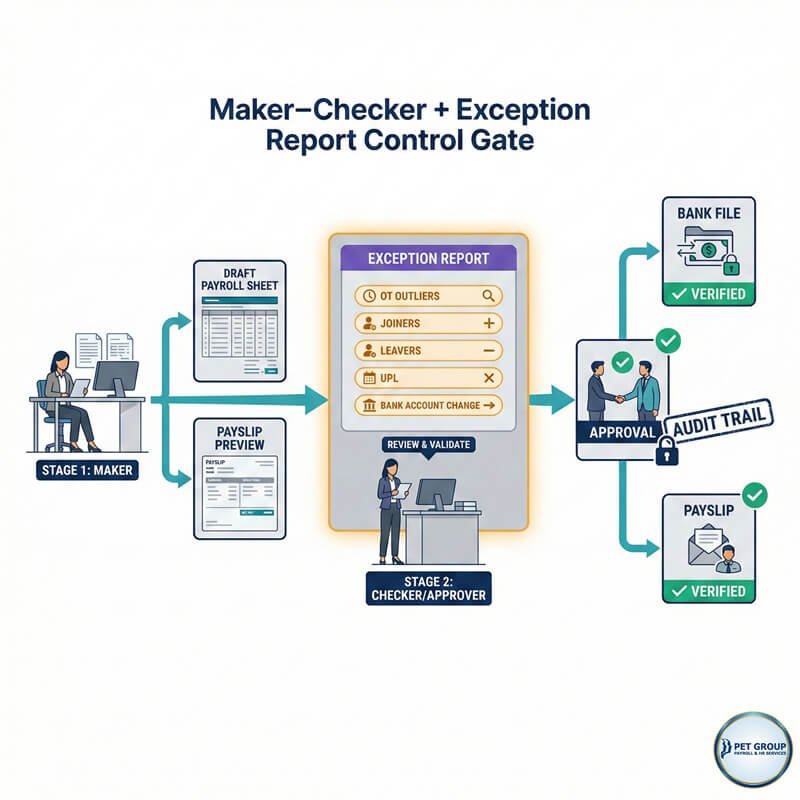
What is maker-checker in payroll, and why does it reduce rework? Maker-checker is an internal control workflow where one party prepares the payroll (the maker) and another party reviews and validates the results (the checker/approver) before any funds are released. In this case study, PET Group acted as the maker, preparing the monthly run based on the standardised outlet inputs. We then provided an Exception Report a critical deliverable that highlights OT outliers, new hires, resignations, and unpaid leave (UPL) days to the client’s finance manager for checker-level verification.
This multi-stage approval workflow ensures that errors are caught during the review window, rather than after salaries are paid. For F&B operators in hubs like Petaling Jaya, Subang Jaya, or Johor Bahru, this “audit trail” is essential for financial accountability. By highlighting OT outliers (unusually high hours compared to the outlet average), we allow management to investigate potential inaccuracies or operational inefficiencies in real-time. This professional care ensures that your restaurant payroll Malaysia remains transparent and protected from administrative drift or fraudulent claims.
A professional maker-checker workflow provides the quality assurance needed for shift-based businesses. We support management across the Klang Valley and Johor by providing the tools needed to professionalise these monthly salary inputs, ensuring your workforce is supported by a reliable and transparent system.
Predictable Outcomes: The Result of Disciplined Rhythms
The outcome of standardising F&B payroll is a shift toward operational predictability. By enforcing a single cut-off calendar and maker-checker approvals, the client achieved cleaner salary runs with fewer ad-hoc edits. Public holidays in Malaysia such as Federal Territory Day in KL or the Sultan of Johor’s Birthday in JB are no longer “surprises” that break the bank file timeline. Instead, the payroll processing timeline Malaysia is pre-adjusted, ensuring staff in Bangsar, Mont Kiara, or Subang Jaya receive their payslips on time, every month.
For the management team, the primary benefit was a clearer audit trail for labor costs. The Exception Report and OT Outlier analysis provided the visibility needed to control payroll budgets across multiple locations. By standardising these outputs, the administrative burden on outlet managers was reduced, allowing them to focus on service while PET Group managed the statutory contribution checklist and regulatory compliance. This professional care ensures that your restaurant payroll Malaysia remains a silent, reliable engine that supports business growth throughout the Klang Valley and beyond.
Our payroll services Malaysia provide the guidance needed to manage these operational nuances. We help you build a resilient monthly rhythm that accounts for holidays and OT outliers, serving clients across Selangor, KL, and Johor with expert strategy and consistent execution support.
Deliverables: Visibility Beyond the Payslip
What is an exception report in payroll? An exception report is a monthly document that explicitly lists all variances from the standard monthly salary run such as OT outliers, joiners, leavers, and unusual shift allowances allowing management to focus only on the items that require validation. Our F&B client receives a comprehensive suite of deliverables each month, including the full payroll run, digital payslips, and a statutory contribution checklist aligned to EPF (KWSP), SOCSO (PERKESO), and PCB (LHDN) standards.
Maintaining a professional reporting rhythm is about long-term audit readiness. For businesses in Subang Jaya, Klang, or Johor Bahru, this ensures that your company remains in good standing with Malaysian authorities. We provide the monthly files needed for secure bank disbursement and statutory filing, avoiding late payment interest and penalties. By standardising these outputs, we allow you to focus on growing your restaurant brand while we manage the intricate operational details. Our goal is to provide the transparency needed to move your SME from reactive processing to a disciplined, repeatable monthly system across the Klang Valley.
Our payroll administration outsourcing consultants provide the strategy needed to professionalise your monthly deliverables, serving clients across Malaysia with expert execution support.
Case Study Replication Checklist: Steps for F&B Operators

Enforce Attendance Lock Dates
Eliminate last-minute panic for your outlets in KL or Selangor. By establishing a firm attendance lock date (e.g., T-7), you ensure all shift hours are verified by outlet managers before central processing begins, protecting the group from avoidable errors.
Analyse OT Outlier Reports
Maintain total oversight of monthly restaurant payroll Malaysia runs. Our outlier reports flag unusually high hours per outlet, allowing your finance team in Petaling Jaya or Johor Bahru to investigate anomalies before they become payment disputes.
Standardise Submission Templates
Move away from “WhatsApp approvals” and multiple email threads. Using a single secure handover template for shift data ensures that records in hubs like Mont Kiara or Subang Jaya remain auditable and PDPA-compliant from the start.
FAQ: F&B Payroll Operations & Control
What is a payroll cut-off calendar?
Why face last-minute payroll?
What is maker-checker in payroll?
What is an exception report?
How standardise outlet OT submissions?
Do you support remote workflows?
Audit Your Shift Payroll Rhythm
Evaluate your monthly attendance lock standards and OT outlier accuracy for your Malaysia restaurant chain.
Operational Audit Complete
Your Shift Process Readiness Score:
WhatsApp PET Group to discuss how a structured attendance lock date can stop last-minute payroll chaos.
Why Professionalise Your Restaurant Payroll Schedule?
Standardising F&B payroll transforms chaotic salary processing into a structured, high-performance operation. By establishing a professional payroll cut-off calendar Malaysia, you protect your chain from the compliance risks associated with late statutory filings and manual attendance errors. Every monthly schedule we design for F&B operators focuses on realistic handover dates, attendance lock planning, and PDPA-aware security standards. This disciplined approach ensures that your team in Kuala Lumpur, Selangor, or Johor Bahru is supported by a reliable system, allowing restaurant owners to focus on growth while we manage the intricate details of shift processing.
| Operational Focus | Reactive F&B Processing | PET Group Case Study Outcome |
|---|---|---|
| Cut-Off Strategy | Undefined lock dates. Data changes continuously during processing, causing last-minute errors. | Predictable. A firm attendance lock date (T-7) allows for thorough outlier review before sign-off. |
| OT Submission | WhatsApp-based approvals. No audit trail for shift hours, meal allowances, or split shift claims. | Policy-Based. Standardised secure templates ensure all hours are calculated against consistent group rules. |
| Audit Trail | None. Rushed runs often mean exceptions (new joiners/resignations) are missed until payslips are out. | Maker-Checker. Formal review window with an Exception Report flags headcount changes before bank release. |
| Budget Visibility | Opaque. Labor costs are only known after disbursement, making it hard to manage outlet-level P&L. | Transparent. Variance reporting highlights OT outliers per outlet, enabling management investigation. |
| Statutory Hygiene | Fragmented. Rushed manual edits increase the risk of incorrect EPF and PCB contributions. | Disciplined. A reconciled statutory checklist aligned with payslips ensures audit-ready compliance records. |
Invite Questions: Review Your F&B Payroll Control
Ensuring your multi-outlet restaurant chain remains audit-ready requires more than just software it requires a managed operational rhythm. Join our established managed service to build administrative discipline, fix your monthly attendance lock dates, and protect your labor budgets from "WhatsApp-based" chaos. Whether you are an SME in Kuala Lumpur or have outlets across Petaling Jaya, Shah Alam, or Johor Bahru, we invite questions about OT policy-based rules, exception reporting, maker-checker approvals, and statutory timelines. Contact PET Group today to receive our latest restaurant payroll service scope and learn how to replicate this case study’s outcomes in your office.


