United Kingdom (RTI) – Fixing ‘Late FPS’ by Aligning Payroll Finalisation With Pay Day
For UK employers, Real Time Information (RTI) reporting is the critical operational link between your business and HMRC. This case study explores how PET Group helped an anonymised UK employer (15–80 staff) resolve “Late FPS” risks by re-aligning their monthly payroll rhythm. By shifting from retrospective corrections to a proactive “on or before payday” routine, the business eliminated record confusion and administrative rework.
What is a UK RTI Payday Routine and Why is it Essential?
Real Time Information (RTI) is the HMRC reporting system where employers must report tax, National Insurance, and pay data every time an employee is paid. A Full Payment Submission (FPS) is the specific report that contains these details. For UK businesses, an RTI payday routine is the operational sequence that ensures the FPS is finalised and submitted alongside the actual fund transfer. Without a disciplined routine, submissions often drift past payday, resulting in “late FPS” flags and potential HMRC penalties. Always verify the latest official guidance from HMRC to ensure your reporting obligations are met.
In growing UK entities, particularly those with occasional bonuses or mid-month adjustments, a retroactive reporting style creates messy records. When payroll is finalised after payments are released, corrections often spill into the “next month,” making it difficult to reconcile YTD figures. By treating the RTI submission as the final “sign-off” of the payday workflow, the business moves from reactive fixing to proactive control. At PET Group, we help employers across the UK from London to Glasgow build this rhythm so that payroll remains transparent and auditable.
An effective RTI routine facilitates better internal governance by creating a clear “buffer time” for validation. This allows for variance checks on joiners, leavers, and one-off adjustments before the FPS event is triggered. By standardising your workflow across your nationwide operations, you create a professional administrative environment where salary processing is a predictable, documented event. PET Group serves as your operational strategist, ensuring your UK payroll reporting is grounded in a repeatable, non-negotiable system that satisfies HMRC requirements while reducing internal chaos.
PET Group specialises in UK payroll outsourcing, helping SMEs with 15–80 staff professionalise their back-office controls. We provide the operational expertise needed to turn RTI reporting into a non-negotiable step in your payday workflow, ensuring a smooth process from data cut-off to final HMRC submission.
Establishing a Firm UK Payroll Cut-Off for RTI Accuracy
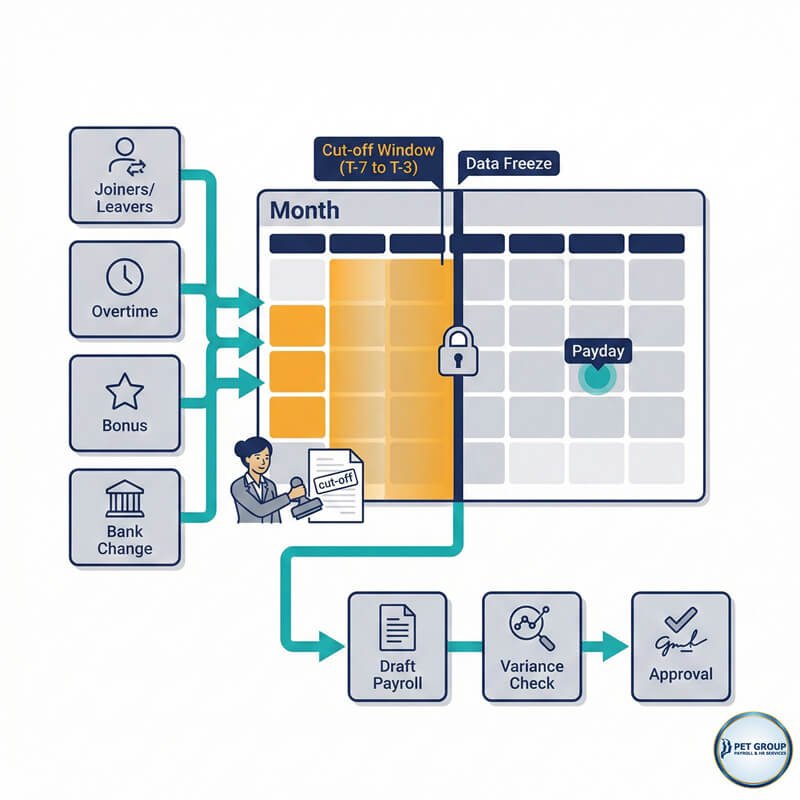
A firm payroll cut-off date is the administrative deadline for submitting all pay changes, including new starters, leavers, overtime, and bonuses. In the context of HMRC RTI reporting, selecting the right cut-off is essential for data integrity. For UK businesses in London, Leeds, or Bristol, a common pattern is 3 to 7 business days before payday. This “data freeze” period allows our team to perform outlier checks and ensures that FPS figures are finalised against verified inputs before the reports are transmitted to HMRC.
When selecting a cut-off date for your UK entity, consider the complexity of your monthly adjustments. If you have frequent bonus cycles or high turnover in locations like Manchester or Birmingham, an earlier cut-off provides management with the necessary time to review the monthly audit trail pack. At PET Group, we help you analyze these operational trade-offs to implement a cut-off policy that minimises post-payday rework and provides clear evidence of approval for every RTI submission.
Setting a disciplined cut-off is the first step toward a “late-free” UK payroll cycle. By standardising this deadline across your nationwide operations, you ensure every FPS report is grounded in complete data, leading to a professional and audit-ready rhythm that reduces administrative friction.

The UK Payday Close Checklist (T-Minus Logic)
For a professional UK RTI timeline, we recommend a relative schedule based on business days. For SMEs in London, Birmingham, or Manchester, a typical payday close checklist looks like this:
T-5 Business Days: Input Deadline – All monthly changes (joiners, leavers, bonuses) must be submitted.
T-4: Draft Generation – Payroll calculation and validation of variances against the previous month.
T-3: Payroll Sign-Off – Management reviews the monthly audit trail pack and provides formal approval.
T-2: Finalisation – Completion of all records; no further changes are accepted for the current cycle.
T-1: Payment Preparation – BACS file generation and final administrative checks.
T (Payday): Release funds and submit the Full Payment Submission (FPS) to HMRC.
Our payday close checklist ensures that UK management has sufficient time to review costs before disbursement. This “T-minus” approach accounts for banking realities and HMRC’s “on or before payday” requirement. We also adjust for bank holidays in England, Wales, Scotland, or Northern Ireland that might shift banking days. By adopting this structured routine, PET Group helps your UK entity move from reactive processing to a disciplined, auditable payday system that keeps employees and HMRC synchronised.
By standardising this template, PET Group helps your UK operation establish a professional payroll rhythm. We act as your operations partner, providing the discipline needed to manage RTI runs with absolute consistency across all UK regions.

The Sign-Off Record: Approvals & Audit Trails
For a secure UK payroll operation, the sign-off record is your protection against record confusion. It documents the transition from raw inputs to final HMRC submission through a consolidated pack including:
Responsibilities Matrix: A definition of who submits inputs, who validates drafts, and who provides final approval.
Approval Evidence: A date-stamped record of who authorised the pay run and when (version control).
Exception Notes: Documentation for any bonuses, leaver final pays, or one-off adjustments with reason notes.
HMRC Receipt: The final confirmation of the FPS submission. By maintaining this pack every payday, UK SMEs in London, Birmingham, or Bristol reduce the risk of “memory-based payroll” and ensure operations are fully auditable.
Accuracy at the sign-off stage is critical for RTI compliance. For UK businesses with growing workforces in areas like Cardiff, Belfast, or Newcastle, we recommend a “Maker-Checker” workflow. This ensures that by the time the FPS is reported to HMRC, it has been internally verified with a clear audit trail. We help you establish this evidence-based rhythm through our UK payroll outsourcing services, providing the operational controls needed to manage headcount costs with complete confidence.
A professional sign-off record ensures that your UK RTI reporting remains steady and auditable. We support entities nationwide by providing the tools needed to professionalise these payday close steps, ensuring your workforce is backed by a reliable system.

Handling Late Inputs and Exception Rules
In any realistic UK monthly payroll routine, late inputs are the primary cause of operational chaos. When a bonus instruction or a leaver notification arrives after the finalised cut-off, it often triggers “rework” that risks the timely submission of the FPS. To prevent this, we implement a clear exception rule: late inputs are automatically processed in the next month’s cycle unless they are approved as “urgent” via a documented exception path. This reduces pressure on the finance team and ensures the current payday remains stable.
Retrospective corrections where an error is fixed by adjusting the next month’s submission are a standard HMRC-compliant method, but they must be documented clearly in an exception log. By avoiding ad-hoc, manual changes to a finalised run, you maintain a cleaner audit trail. At PET Group, we help UK employers in areas like London, Leeds, and Manchester manage these “outlier” events proactively. This approach ensures that your UK RTI data remains consistent and auditable across all locations, minimising the risk of HMRC compliance alerts. Always verify the latest HMRC guidance for handling specific payroll errors.
Our UK payroll outsourcing services provide the process controls needed to handle these operational nuances. We help you build a resilient routine that accounts for late inputs without breaking the pay cycle, serving clients across the UK with expert strategy and consistent execution support.

RTI Deadlines: The “On or Before Payday” Principle
Our UK payroll services prioritise the “on or before payday” reporting requirement. While some administrative steps can be performed later, the FPS must generally be submitted at the time of payment release. We help UK SME owners track these deadlines precisely. By integrating the RTI submission as the final close of the payday checklist, we ensure that your reporting is never delayed. This professional care prevents the administrative drift that leads to HMRC flags, allowing you to focus on your core UK operations while we manage the intricate reporting details.
Maintaining a professional reporting rhythm is about long-term audit readiness. For businesses in Glasgow, Belfast, or London, this ensures that your group remains in good standing with HMRC authorities. We help you understand how RTI reporting interacts with PAYE and National Insurance deadlines. This professional oversight prevents the month-end “rework” that plagues disorganized payroll systems. By standardising these outputs, we provide a silent, reliable engine that keeps your UK payroll running smoothly and legally throughout the country. Always verify latest official HMRC guidance for specific reporting rules.
Our UK payroll operations specialists provide the strategy needed to professionalise your RTI reporting rhythm, serving clients nationwide with expert execution support.

From RTI Panic to Auditable Payday Routines

Disciplined Workflow Control
Eliminate “Late FPS” panic for your UK team. By establishing firm monthly cut-offs, we ensure all bonuses and leaver final pays are validated before processing, protecting your business from administrative drift and rework.
Repeatable Audit Trail Packs
Maintain total oversight of every payday. Our monthly audit trail packs are designed for management sign-off, ensuring your business in London or Manchester is always audit-ready with clear documentation of leavers, joiners, and variances.
Secure FPS Submission Paths
Embed HMRC reporting as a mandatory “done” state for every monthly cycle. Our workflows ensure that final RTI submissions happen nationwide across the UK through secure channels, with automatic FPS receipts captured every payday.
FAQ: UK RTI Payday Routines & Operational Strategy
What is HMRC RTI and an FPS?
When is an FPS generally due?
What causes “Late FPS” issues?
What is a payroll finalisation checklist?
What should a sign-off record include?
How should you handle late inputs?
Do you support UK-wide groups?
What is the safest way to fix errors?
How can PET Group help my SME?
UK RTI Payday Alignment Readiness Audit
Evaluate your readiness for HMRC “on or before payday” compliance and sign-off control.
Audit Complete
Your Payday Alignment Readiness:
WhatsApp PET Group to review your UK RTI Payday Alignment Audit and next steps.
Why Professionalise Your UK RTI Payday Workflow?
Our UK payroll outsourcing model transforms chaotic month-end reporting into a structured, high-performance operation. By establishing a professional payday close routine, you protect your business from the "late FPS" flags associated with retrospective reporting. Every workflow we design focuses on realistic cut-off dates, auditable sign-off records, and firm late input rules. This disciplined approach ensures that your UK team whether based in London, Manchester, or Birmingham is backed by a reliable system, allowing finance managers to focus on strategy while we manage the intricate RTI reporting details for HMRC.
| Operational Focus | Retrospective Reporting | PET Group RTI Routine |
|---|---|---|
| FPS Timing | Detached. Submission often drifts days after payday, risking "Late FPS" flags from HMRC. | Integrated. FPS submission is the final non-negotiable step in the payday routine. |
| Workflow Control | Lax. Adjustments and bonus reasons are confirmed after payment, causing record mismatch. | Disciplined. Firm T-minus sequence ensures all inputs and sign-offs are finalised before fund release. |
| Audit Trails | Fragmented. Evidence of management sign-off is buried in various emails or verbal chats. | Consolidated. Monthly audit trail pack captures every approval, leaver note, and FPS receipt. |
| Late Inputs | Reactive. Late changes result in rework of finalised bank files, increasing error risk. | Systematic. Clear exception rule default to next cycle reduces month-end pressure and chaos. |
| Record Clarity | Low. Repeated corrections make month-to-month reconciliation difficult and time-consuming. | High. Payday alignment ensures bank payments and RTI reports are 100% synchronised every month. |
Review Your UK RTI Payday Routine
Ensuring your UK entity remains auditable and compliant requires administrative discipline. PET Group helps you transition from retroactive fixing to a professional payday close rhythm, protecting your business from the friction of "Late FPS" flags. Whether you operate in London, Birmingham, Manchester, or Leeds, we invite you to professionalise your RTI sequence. Contact us today to receive our operational service scope and a sample monthly audit trail pack. We are here to answer questions about cut-off owners, sign-off record design, RACI matrix setup, and the rhythm of secure RTI submissions. Let us help you move toward a protected and professional UK back-office operation.


