Manufacturing (Malaysia) Stabilising Mixed Workforce Payroll Through Input Control
For Malaysia’s manufacturing and warehouse sectors, attendance-heavy payroll is often the primary source of administrative instability. This case study explores how PET Group helped an anonymised local operator (80–250 staff) resolve data governance risks by enforcing a controlled input flow from attendance lock to statutory close.
What is Manufacturing Payroll Outsourcing in Malaysia?
Manufacturing payroll outsourcing is a specialized service designed to manage the high-volume attendance, complex overtime (OT), and diverse allowance structures typical of factory and warehouse environments. In Malaysia, this process must handle mixed workforces both local and foreign where data classification, levy deductions, and statutory contribution rules differ. A controlled outsourcing routine ensures that timesheet validations and allowance changes are audited before the pay run begins. Without this discipline, payroll instability often leads to disputed adjustments and non-compliance risks. Always verify the latest official guidance from LHDN, KWSP, and PERKESO.
In growing Malaysian factories, particularly those with shift patterns or high OT variability in industrial hubs like Klang Valley or Johor, manual payroll updates create significant risk. When data is edited after the cut-off without supporting notes, the audit trail breaks. By implementing an “Attendance-to-Approval” workflow, the business moves from reactive patching to structured governance. At PET Group, we help manufacturing SMEs build this rhythm so that payroll remains transparent and easily defendable during internal reviews or external audits by authorities.
An effective manufacturing payroll routine facilitates better operational control by creating a clear “lock date” for attendance. This prevents last-minute timesheet changes that cause calculation errors for shift workers or warehouse staff. By standardising these controls across your production sites, you create a professional administrative environment where salary processing is a documented, predictable event. PET Group acts as your operational strategist, ensuring your payroll reporting is grounded in a repeatable, non-negotiable system that satisfies statutory requirements while reducing back-office chaos.
PET Group specialises in manufacturing payroll outsourcing, helping factories with 80–250 staff professionalise their back-office controls. We provide the operational expertise needed to turn high-volume attendance data into an auditable payroll close pack, ensuring a smooth process from OT validation to final statutory remittance.
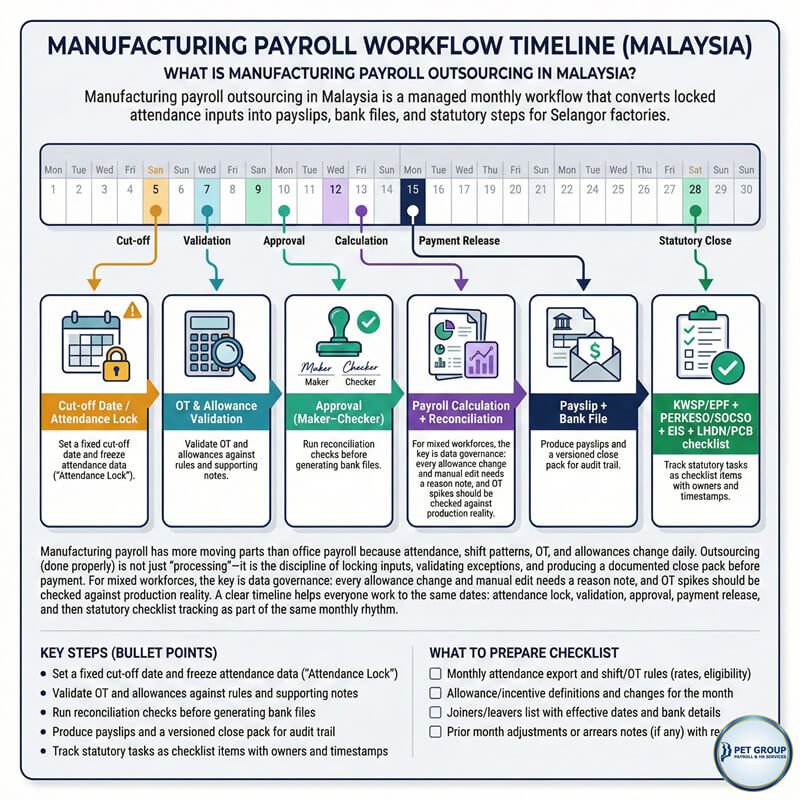
Establishing Attendance Lock Dates for OT Accuracy
An attendance lock date is the administrative deadline where all timesheet data is frozen for processing. For Malaysian manufacturing entities in industrial zones like Petaling Jaya, Shah Alam, or Pasir Gudang, selecting the right lock date is essential for overtime integrity. A common pattern is 3 to 5 business days before the payment date. This “data freeze” period allows our team to run variance checks on OT spikes by department and ensures that leavers or joiners are properly classified before the calculation begins.
When setting a lock date for your factory, consider the volume of shift patterns and allowance variability. If you have high headcount turnover or frequent allowance adjustments in locations like Subang or Johor Bahru, a disciplined cut-off provides production managers with the necessary time to review the monthly attendance audit pack. At PET Group, we help you analyze these operational trade-offs to implement a lock policy that minimises disputes and provides clear evidence of approval for every overtime and allowance payment.
Enforcing a disciplined lock date is the first step toward a stable manufacturing payroll cycle. By standardising this deadline, you ensure every pay run is grounded in verified attendance data, leading to a professional and audit-ready rhythm that reduces administrative friction for both HR and Finance teams.

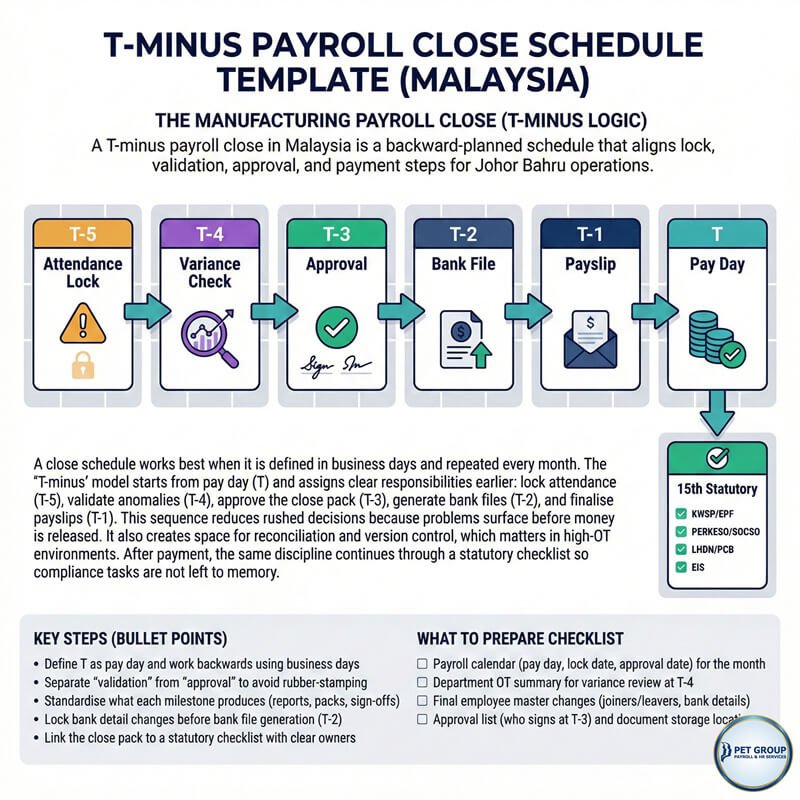
The Manufacturing Payroll Close (T-Minus Logic)
For an audit-ready production cycle, we recommend a relative schedule based on business days. For factory SMEs in the Klang Valley or Johor, a typical Close Pack sequence follows this “T-Minus” logic:
T-5 Business Days: Attendance Lock – All timesheets and OT data are frozen. No further changes allowed for the current run.
T-4: Variance Check & Validation – Payroll calculation and cross-checking of OT spikes or manual edits against supporting notes.
T-3: Management Approval – Plant managers or Finance review the audit trail pack and provide formal approval for disbursement.
T-2: Payment File Preparation – Final generation of bank files and checking for joiner/leaver bank detail accuracy.
T-1: Final Close & Sync – Completion of all records; preparation of pay slips for mixed local and foreign workers.
T (Pay Day): Release Funds – Salaries disbursed. Statutory checklist initiated for next month’s remittance.
Our Close Pack ensures that manufacturing management has sufficient time to validate shift costs before disbursement. This “T-minus” approach accounts for banking realities and the need to track statutory deadlines like EPF/SOCSO/MTD (on or before the 15th). By adopting this structured routine, PET Group helps your factory move from reactive processing to a disciplined system that keeps employees and authorities synchronised across your nationwide operations.
By standardising this template, PET Group helps your manufacturing operation establish a professional payroll rhythm. We act as your operations partner, providing the discipline needed to manage high-volume OT runs with absolute consistency.
The Evidence Pack: Variance Checks & Approvals
For a secure factory operation, the Evidence Pack is your protection against calculation disputes and audit gaps. It documents the transition from raw inputs to finalised salary disbursement through a consolidated pack including:
Variance Check Logs: Reports showing OT spikes by department or repeated manual edits that trigger a management review.
Allowance Notes: Mandatory documentation for any change in shift allowance, transport subsidy, or hardship pay with evidence notes.
Approval Evidence: A date-stamped record of who authorised the production pay run and the basis for the approval (version control).
Statutory Tracker: Evidence that EPF, SOCSO, and MTD steps are tracked with owners and timestamps for the upcoming 15th deadline.
Accuracy at the variance check stage is critical for manufacturing payroll stability. For businesses with mixed workforces in hubs like Batu Caves, Shah Alam, or Johor Bahru, we recommend a “Maker-Checker-Approver” workflow. This ensures that by the time funds are released, the figures have been internally verified against physical attendance logs and production schedules. We help you establish this evidence-based rhythm through our operational controls, providing the oversight needed to manage high-volume payroll with complete confidence.
A professional Evidence Pack ensures that your manufacturing payroll remains steady and auditable. We support entities nationwide by professionalising these Close Pack steps, ensuring your workforce is backed by a reliable system.

Managing Allowance Changes and Manual Edits
In high-volume manufacturing payroll, manual edits are the primary cause of operational chaos. When a transport allowance or production incentive is changed after the cut-off, it often triggers “rework” that risks the timely close of the pay run. To prevent this, we implement a clear Exception Policy: manual edits require mandatory reason notes and supporting evidence. If a change arrives after the lock date, it is scheduled for the next cycle unless approved as “urgent” via a documented path. This protects the stability of the current pay run.
Controlled input flow means that every change must have a “why” attached. By avoiding ad-hoc adjustments to a finalised run, you maintain a cleaner audit trail. At PET Group, we help manufacturing employers in areas like Petaling Jaya, Rawang, and Senai manage these “outlier” events proactively. This approach ensures that your mixed workforce data remains consistent and auditable, minimising the risk of internal disputes or statutory compliance alerts. Always verify the latest official guidance regarding employee category classification and contribution rules.
Our manufacturing payroll services provide the process controls needed to handle these operational nuances. We help you build a resilient routine that accounts for shift variability without breaking the pay cycle, serving clients across Malaysia with expert strategy and consistent support.

Statutory Timelines: The “15th of Next Month” Standard
Our manufacturing payroll services prioritize the visibility of statutory contribution steps. In Malaysia, major remittances typically follow firm guidelines: EPF (KWSP), SOCSO (PERKESO/EIS), and MTD/PCB (LHDN) are generally due on or before the 15th of the following month. We help factory owners integrate these deadlines into the same Close Pack used for salaries. By tracking these steps with owners and timestamps, we ensure that your compliance is never left to the last minute. This prevents administrative drift and allows you to focus on core production while we manage the intricate reporting details. Always verify latest official guidance.
Maintaining a professional reporting rhythm is about long-term audit readiness. For businesses in areas like Klang, Johor Bahru, or Shah Alam, this ensures your entity remains in good standing with Malaysian authorities. We help you understand how statutory steps interact with your monthly payroll close. This professional oversight prevents the “rework” that plagues disorganized systems with high OT volume. By standardising these outputs, we provide a silent, reliable engine that keeps your manufacturing payroll running smoothly and correctly nationwide. Always verify latest official guidance for specific contribution rules.
Our manufacturing payroll specialists provide the strategy needed to professionalise your statutory tracking, serving clients nationwide with expert execution and operational support.

From Payroll Chaos to Controlled Manufacturing Routines

Attendance Lock & OT Validation
Eliminate OT calculation panic for your factory team. By establishing firm attendance lock dates, we ensure all shift data and incentives are validated before processing, protecting your production site from administrative rework.
Auditable Variance Checks
Maintain total oversight of mixed workforce costs. Our monthly variance check logs are designed for management sign-off, ensuring your warehouse in Klang or JB is always audit-ready with clear documentation of spikes and incentive changes.
Statutory Checklist Tracking
Embed remittance visibility as a mandatory “done” state for every cycle. Our workflows ensure that EPF, SOCSO, and MTD steps are tracked with owners and timestamps, preventing last-minute panics across all factory production regions.
FAQ: Manufacturing Payroll Stability & Operational Controls
What causes payroll instability?
What is an attendance lock date?
Why run variance checks?
What is a Evidence Pack?
How do you handle late manual edits?
Do you support Klang & Johor?
What are the statutory rules?
Is mixed workforce more complex?
How can PET Group help my SME?
Manufacturing Payroll Stability Readiness Audit
Evaluate your readiness for high-volume OT control and statutory checklist discipline.
Audit Complete
Your Operations Readiness:
WhatsApp PET Group to review your Manufacturing Payroll Stability Readiness Audit and next steps.
Why Professionalise Your Production Payroll Workflow?
Our manufacturing payroll outsourcing model transforms chaotic data entry into a structured, high-performance operation. By establishing a professional Close Pack routine, you protect your business from the "instability" associated with loose attendance records. Every workflow we design focuses on realistic lock dates, auditable variance check logs, and firm allowance control rules. This disciplined approach ensures that your team whether in Shah Alam, Klang, or Pasir Gudang is backed by a reliable system, allowing production managers to focus on output while we manage the intricate statutory details for authorities.
| Operational Focus | Fragmented Manufacturing Payroll | PET Group Close Pack Routine |
|---|---|---|
| Attendance Input | Loose lock dates. Last-minute timesheet changes cause calculation errors for OT. | Disciplined lock dates. Data is frozen early to allow for validation and spike checks. |
| Manual Edits | Frequent. Edits arrive without reason notes, breaking the audit trail for shift premiums. | Documented. Every manual edit requires mandatory reason notes and supporting evidence. |
| Variance Control | Reactive. OT spikes are only investigated after payment, leading to disputes. | Proactive. Variance check logs catch departmental outliers before salary release. |
| Mixed Workforce | Basic. Static handling of local and foreign workers, risking contribution errors. | Granular. Data classification ensures deduction accuracy for mixed employee categories. |
| Statutory Close | Distant. Remittances are treated as a separate task, risking late payment flags. | Integrated. Statutory checklists are part of the Close Pack with owners and timestamps. |
Review Your Manufacturing Payroll Stability Audit
Ensuring your factory or warehouse remains auditable and compliant requires operational discipline. PET Group helps you transition from fragmented data entry to a professional Close Pack rhythm, protecting your business from the friction of attendance disputes and OT spikes. Whether you operate in Klang Valley or Johor Bahru, we invite you to professionalise your payroll sequence. Contact us today to receive our operational service scope and a sample Close Pack audit trail. We are here to answer questions about attendance lock owners, variance check design, mixed workforce controls, and statutory checklist tracking. Let us help you move toward a protected and professional manufacturing back-office operation.


