Payroll Security Guides (Employer Operations Library)
Payroll data represents some of the most sensitive information an employer handles, including bank details, salary levels, and personal ID numbers. Our payroll security guides provide general operational guidance for employers in Malaysia and Singapore to establish minimum access and high traceability across their monthly cycles. This library defines how to move away from shared mailboxes and open folders toward role-based access control (RBAC) and maker-checker approvals.
Establishing Payroll Data Security
Payroll data security is the implementation of technical and administrative controls to protect compensation records from unauthorised access or leakage. This library serves as a roadmap for organisations in Singapore and Malaysia to move beyond informal habits toward a professionalised security framework. It defines the “least privilege” principle, ensuring that only necessary personnel in Finance or HR can view sensitive pay grades or bank details. By following these guides, employers establish a controlled environment where every salary adjustment is logged and every payslip is distributed through encrypted, role-based channels. This protects your operational integrity across diverse regional sites from Penang and Johor Bahru to Jurong and Tampines.
To navigate these resources, start by reviewing your “Access Control List” to identify who currently has visibility over your payroll files. Stable security depends on standardising how data is handed over between HR and Finance to prevent unencrypted email chains that create data leakage risks. You may also review our guides on payslip confidentiality or specific requirements for Malaysia and Singapore. By aligning your internal access rules with these operational benchmarks, you ensure that your payroll register is supported by clear evidence of approval and a verifiable audit trail that satisfies internal governance needs.
Whether you are managing a service office in Raffles Place or a manufacturing plant in Shah Alam and Ipoh, these resources explain how to manage payroll security and PDPA-aligned data retention. We focus on the practical “how-to” of offboarding access removal, ensuring that ex-employees no longer have visibility into internal payroll portals. This library empowers Finance Directors and HR Managers to implement repeatable verification steps, ensuring that payroll registers, exception logs, and bank instructions are handled with the highest level of confidentiality every month.
Our strategy focuses on empowering employers with the practical controls required to manage payroll security with consistency across the Klang Valley, Johor, Penang, and all Singapore regions.
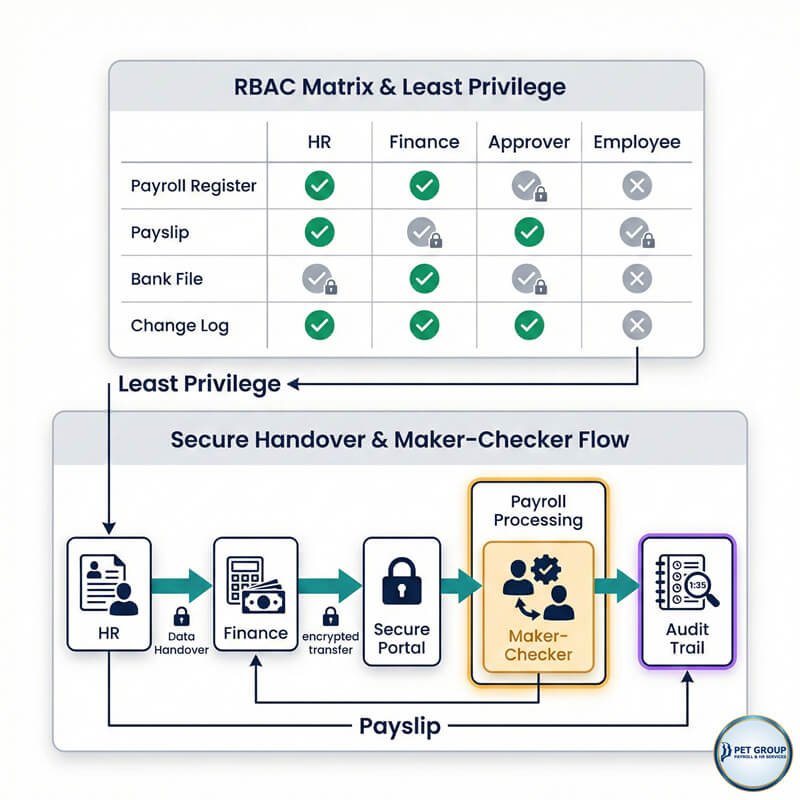
Common Failures in Payroll Access Control
Payroll security risks often emerge when organisations rely on shared logins or informal file-sharing methods. Common failure points include using personal chat apps for payroll registers, storing payslips in shared folders with open permissions, and failing to revoke access for ex-employees in a timely manner. These issues create traceability gaps that complicate internal audits and increase the risk of insider leakage. Our guides identify these operational risks early, providing simple controls to ensure that only authorized personnel can view salary data, whether your team is in Petaling Jaya, Kuching, or Jurong East.
Practical security involves fixing the habit of forwarding payslips by unencrypted email or leaving physical payroll reports on shared printers. In distributed teams from Kuala Lumpur to Singapore’s Marina Bay, the lack of a “maker-checker” approval workflow often means salary errors or unauthorised changes go unnoticed. By implementing role-based access control (RBAC), you ensure that visibility is restricted to the “least privilege” necessary for a job role. Professionalising your governance model ensures that every payroll change is backed by evidence, maintaining operational trust and data integrity across your entire workforce.
Secure payroll processing starts with disciplined access rules and verifiable evidence. Our library helps you professionalise these foundations across all Malaysia and Singapore regions.

The 8 Pillars of Payroll Security
Our library covers 8 essential operational areas to ensure your Malaysia and Singapore payroll cycles are handled with security and discipline:
1. Role-Based Access Control (RBAC) – Restricting visibility to sensitive salary data based on job necessity, ensuring “least privilege” for HR and Finance users.
2. Secure File Handover – Moving away from insecure email attachments toward encrypted transfers or secure portals for monthly payroll input data.
3. Maker-Checker Approvals – Implementing a two-step verification where every pay adjustment is checked by a second officer against authorised source documents.
4. Access Revocation (Offboarding) – Establishing a strict checklist to remove ex-employee access to payroll portals in KL, Johor, or Singapore within 24 hours of exit.
5. Payslip Confidentiality – Ensuring itemized wage statements are delivered through password-protected or role-based secure channels in line with PDPA principles.
6. Audit Trail Logging – Maintaining a “change log” that records who modified what data, when, and why, providing evidence for internal governance reviews.
7. Data Retention Discipline – Following statutory timelines for record keeping while ensuring archived files are stored in encrypted, restricted environments.
8. Bank File Integrity – Using secure staging for FAST/GIRO files and ensuring only authorised signatories can approve the final funds release for salaries.
By using these guides, your organization moves from informal administration to a controlled governance model. This structured approach provides the traceability needed for internal reviews without the friction of data leakage risks. We encourage HR Leads and Finance Managers to follow the library’s path from security basics to advanced audit readiness. This ensures your records remain protected across your operations in states like Selangor, Penang, and Perak, as well as Singapore hubs like Jurong and Tanjong Pagar.
These featured guides provide a roadmap for employer payroll security. We act as your process partner, ensuring your team has the controls needed to protect sensitive data.

Regional Support & Security Standards
Our payroll security guides provide consistent operational standards for employers across all states, from the Klang Valley and Putrajaya to Sabah and Sarawak. We focus on professionalizing your internal workflows to ensure that data protection standards are met before every bank file deadline. This regional coverage ensures your distributed workforce whether in Ipoh, Melaka, or Singapore’s Jurong East follows the same security protocols regardless of their branch location or cost centre allocation.
Finance leads in areas like Cyberjaya, Bayan Lepas, or Singapore’s Changi Business Park must manage precise salary data while maintaining disciplined offboarding rules. Standardizing these steps prevents unauthorized access during sensitive periods like bonus reviews or year-end reporting. Use our library to structure access request logs and minimize administrative friction. This approach ensures your records remain grounded in verified operational data, providing the clarity needed for effective audit trails during internal reviews and PDPA/PDPC compliance checks across your Malaysia and Singapore operations.
Proper security modelling ensures your employer payroll data remains steady and auditable. We provide the expertise needed to professionalize your scaling team administration and access control island-wide and across the peninsula.

Choosing the Right Security Control
Navigating this library depends on your current governance needs. If you are establishing new internal access rules, start with the “RBAC & Access Control” guide to understand role-based visibility. For businesses managing team expansions in areas like Negeri Sembilan, Pahang, or Singapore’s Punggol, our “Offboarding & Removal” checklist provides context for revoking access for leavers. This library is designed to move you from ad-hoc file sharing toward a structured path where every guide reinforces the principles of minimum access and audit traceability across your regional entities.
Still have questions about your payroll security operations? If you are unsure which security guide to fix first from RBAC rules to maker-checker logs we invite you to explore our payroll security readiness audit. Success in payroll data protection depends on process discipline; stable outcomes are only possible through verified access rules and strict handover protocols. We help employers implement these steps through standardized checklists and policy-led governance. By standardizing how your HR and Finance teams handle sensitive files, you protect your organization from common leakage risks in cities like Subang Jaya, Alor Setar, and Singapore’s Woodlands.
Our governance processes provide the operational controls needed to handle sensitive employer payroll data. We help you build a resilient administrative foundation that protects data privacy island-wide and across the peninsula.

FAQ: Payroll Security Operations
What is a payroll audit trail?
Who should access payslips?
What is maker-checker?
Reduce internal leakage?
What is secure handover?
Leaver access removal?
What is least privilege?
Role of encryption?
How to audit access?
Payroll Security Readiness Audit
Evaluate your organisation’s readiness for secure and traceable payroll operations.
Security Audit Complete
Operational Risk Category:
Use this audit to identify which security pillar to strengthen first. WhatsApp us for a process-focused review.
Why Professionalize Your Payroll Security?
Professionalizing your payroll security transforms monthly administration into a predictable, protected management rhythm. By establishing clear RBAC rules and standardized handovers, you protect your organization from common failure points like shared logins or unauthorized data visibility. Every guide in our library focuses on data integrity, maker-checker evidence, and consistent audit-ready archiving. This disciplined approach ensures your Finance team can focus on growth while we support the operational protection of your records, providing a stable foundation for your organization’s governance across the Klang Valley, regional Malaysian states, and Singapore’s industrial and business hubs.
| Operational Control | Weak / Manual Status | Strong Governance Pack |
|---|---|---|
| Access Visibility | Shared mailboxes and open folder permissions. | Strict RBAC with least privilege enforcement. |
| Payslip Delivery | Unencrypted email attachments or paper copies. | Encrypted portal or password-protected delivery. |
| Change Evidence | Informal sign-offs without documented logs. | Maker-checker logs with full audit trails. |
| File Handover | Insecure email chains for sensitive registers. | Secure, encrypted handover protocols. |
| Leaver Discipline | Delayed or forgotten access removal for leavers. | Instant revocation with offboarding evidence. |
Contact Us to Review Your Security Audit
Professionalizing your payroll security ensures data protection and scaling stability across Malaysia and Singapore. PET Group helps Finance leads transition from informal file-sharing to a controlled governance model, protecting your organization from the risks of internal data leakage and unapproved salary edits. We are here to answer questions about RBAC rules, maker-checker evidence logs, and secure payslip distribution standards. Whether you are managing a headquarters in Kuala Lumpur or industrial teams in Johor and Changi, we invite you to stabilize your operational security. Contact us today to review your security audit results and professionalize your organization’s governance.


